

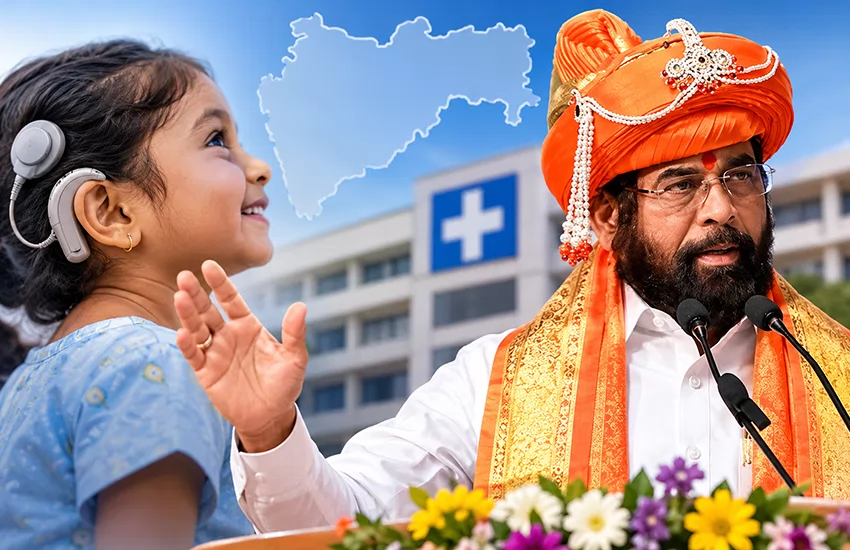
India – The government of Maharashtra, India, is planning to expand cochlear implant surgery and early detection services for children with hearing impairments to municipal hospitals across the state. At present, the Thane Municipal Corporation provides cochlear implant surgery, and the government intends to extend similar services to other municipal corporations.
The planned expansion aims to improve access to early diagnosis, treatment and cochlear implant surgery for children with hearing loss. It could also help families who cannot easily afford treatment or who live far away from specialised medical facilities.
Maharashtra plans to expand cochlear implant services
Maharashtra’s Deputy Chief Minister Eknath Shinde said he would discuss the proposal with Chief Minister Devendra Fadnavis and Public Health Minister Prakashrao Abitkar.
The aim is to ensure that children with hearing impairments receive timely diagnosis and medical treatment at municipal hospitals across Maharashtra.
According to the report, the Thane Municipal Corporation has already introduced cochlear implant surgery, benefiting several children. Part of the surgery costs was reportedly covered by the Chief Minister’s Relief Fund. The municipal corporation has also started offering early detection services.
The government is now considering expanding this model to other municipal hospitals. However, the report does not specify which hospitals will be included, when the expansion will begin or how much funding will be allocated.
Why early diagnosis is considered important
A cochlear implant is an electronic medical device that can help people with severe or profound hearing loss perceive sounds.
Unlike conventional hearing aids, cochlear implants do not simply amplify sound. They process sound and transmit electrical signals to the auditory nerve, allowing some people to perceive sound.
However, the suitability of cochlear implants varies from person to person. Surgery does not guarantee a particular level of hearing, speech development or communication ability. Rehabilitation, training and long-term support are also important.
Shinde particularly emphasised the importance of early treatment for children. He argued that timely surgery could help children develop hearing and speech abilities.
Nevertheless, the outcomes of cochlear implantation differ significantly between individuals and depend on various factors.
A girl was admitted to IIT, another boy selected for ISRO
During the event, Eknath Shinde referred to individual children who had achieved remarkable results following cochlear implant surgery.
According to his statements, one girl who had undergone cochlear implant surgery secured admission to an Indian Institute of Technology (IIT). Another boy was reportedly selected for the Indian Space Research Organisation (ISRO).
These examples were presented to illustrate the opportunities that children may have. However, they are individual cases and cannot be used to draw general conclusions about the outcomes of cochlear implant surgery.
The educational and professional success of deaf and hard-of-hearing people does not depend solely on medical treatment. Education, accessibility, social inclusion, individual support and personal abilities also play important roles.
Support for families in 28 districts
According to Shinde, the Shiv Sena Medical Help Cell and the Dr Shrikant Shinde Foundation have been supporting families of children with hearing impairments and heart conditions for the past nine years.
The initiative reportedly covers 28 districts. Teams visit different regions, including Gadchiroli and Sangli, to identify children who need medical assistance.
Children requiring surgery are then brought to Mumbai for treatment.
Such support could be particularly important for families in remote areas, where access to specialists, medical examinations, surgery and follow-up care may involve considerable costs and long journeys.
Conclusion: Medical care must not be the only solution
Expanding cochlear implant services is fundamentally an important step towards improving access to medical care. However, deafness must not be viewed exclusively as a medical problem that should be eliminated.
Early diagnosis and medical treatment can be valuable for some children and families. At the same time, deaf children need access to education, accessible communication, sign language, qualified teachers and an inclusive environment, regardless of whether they receive a cochlear implant.
Families should also receive comprehensive and impartial information. This should include cochlear implants, hearing aids, rehabilitation, sign language and other communication options. Parents must be able to make informed decisions without unnecessary medical or social pressure.
The planned expansion in Maharashtra could improve access to healthcare. However, it remains to be seen whether the initiative will be implemented, how many children will benefit and whether long-term funding will be secured.


