

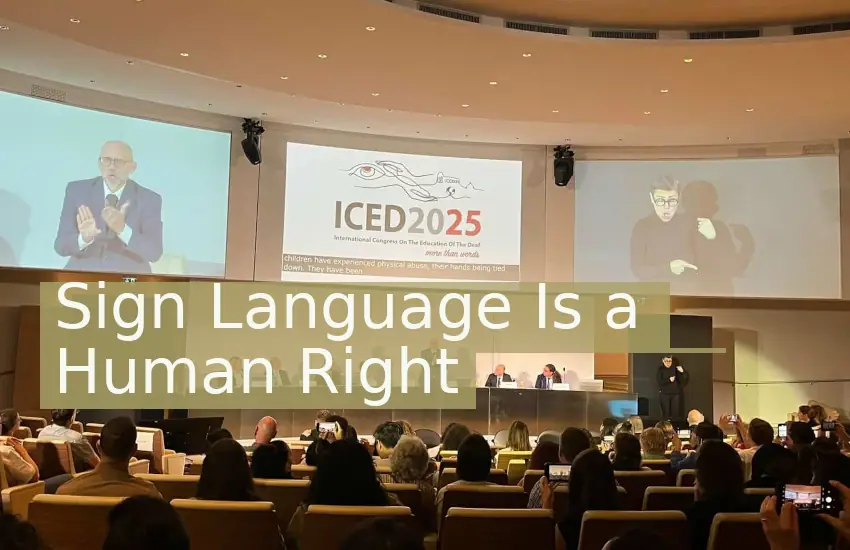
Rome, July 2025 – The 24th International Congress on the Education of the Deaf (ICED) took place in Rome, marking a historic moment for the global Deaf community. For the first time since 1880, when the ICED met in Milan and imposed a long-lasting ban on sign language in deaf education, the international community returned to Italian soil to reject that legacy—and build a new, inclusive future.
At the center of this year’s congress was a Joint Declaration issued by three leading organizations: the World Federation of the Deaf (WFD), the European Union of the Deaf (EUD), and the National Association of the Deaf in Italy (ENS). This declaration urges governments, schools, families, and the general public to recognize sign language as a basic human right and to provide full access to it for all deaf children.
From Milan 1880 to Rome 2025: A Historic Correction
In his powerful opening speech, the President of the WFD addressed a crowd of advocates, educators, and community leaders. He reminded attendees that the last ICED held in Italy—in Milan in 1880—marked a turning point in the wrong direction. That congress aimed to eliminate sign languages from deaf education and promote oralism (the exclusive use of spoken language).
The consequences were devastating.
For 145 years, generations of deaf children around the world were denied access to their natural language. The WFD President called this what it was: language deprivation and human rights abuse. Children were punished for signing. Their hands were tied. They were slapped, shamed, and emotionally isolated. All because they used a language—sign language—that is natural, expressive, and deeply connected to identity.
“How many of you have been denied your right to sign?” he asked the audience. The question echoed through the hall, not as a rhetorical flourish, but as a shared memory of pain and resilience.
No More: Sign Language Is a Human Right
The Rome Congress marked a powerful shift. The message was clear: no more language deprivation. No more forcing deaf children to choose between speaking and signing. No more outdated ideologies that deny families the right to communicate in the most natural and accessible way possible.
The WFD and its partners called for:
- Full access to sign language from birth for all deaf children
- Free sign language instruction for hearing parents and family members
- Recognition of national sign languages as part of every country’s official linguistic landscape
- Legal and educational policies that protect and promote sign language rights
- An official rejection of the 1880 Milan resolutions
The WFD emphasized: Deaf children thrive when they are given early and unrestricted access to sign language. This is not just an educational issue—it is a matter of basic human rights, dignity, and inclusion.
Your Voice Matters: Sign the Declaration
Throughout the week, the ICED featured panels, workshops, and community gatherings. Participants learned about best practices in bilingual education, shared research, and exchanged experiences from across the globe. But the emotional heart of the congress was the Joint Declaration.
This declaration is more than symbolic. It’s a promise to the next generation: that they will not face the same discrimination and isolation as those before them.
The WFD and ENS will officially present the Declaration at the Closing Ceremony on Friday morning, where all participants are invited to sign it. Signing the declaration means:
- You support sign language as a fundamental human right
- You believe every child deserves to communicate freely
- You commit to building a world where Deaf people can sign everywhere, with everyone
Conclusion: A Call to Action for All
The 24th ICED was not only a conference—it was a call to action. It was a place where old wounds were acknowledged, but also where hope was born. The Milan resolutions of 1880 began a long era of injustice. Now, in Rome, that chapter is closing.
Let us move forward together—parents, teachers, interpreters, policy makers, and Deaf leaders—with a shared goal: a world where sign language is respected, taught, used, and celebrated.
Every child deserves to be told, “I love you,” in their own language.
Let us ensure that no deaf child is ever again made to feel ashamed of who they are—or of the way they communicate.
Tips for Families and Allies of Deaf Children
- Start early: If your child is deaf, begin learning sign language as soon as possible. Early exposure helps both language development and emotional bonding.
- Get support: Join local Deaf organizations or parent groups. You’ll meet families with similar experiences and get valuable advice.
- Take classes: Many communities offer free or low-cost sign language courses. Online options are also available.
- Be patient and consistent: Language learning takes time—for both children and adults. Practice every day.
- Advocate for bilingual education: Support schools and teachers that promote sign language alongside spoken/written language.
Would you like this version also as a downloadable Word or PDF file for print or publication?


