

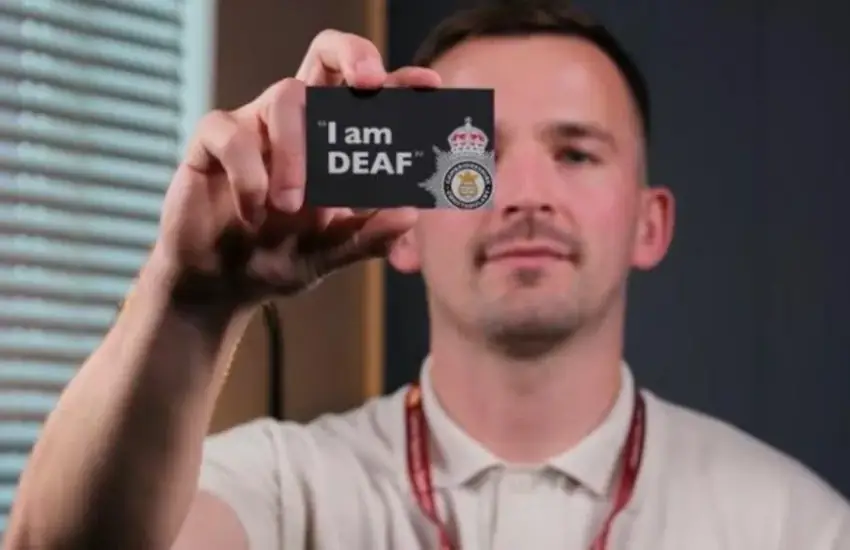
For many deaf people, contact with the police can be stressful and challenging, especially in emergency situations. Communication barriers, misunderstandings, and a lack of awareness often make already difficult moments even harder. In response, Cambridgeshire Police in the UK have introduced a new support tool: a small card reading “I am deaf”, designed to help deaf people communicate more easily with officers.
The initiative was developed in cooperation with the Cambridgeshire Deaf Association (CDA) and aims to improve understanding, safety, and accessibility during police encounters.
What Is the “I Am Deaf” Card?
The card is small and easy to carry in a wallet or pocket. On the front, it clearly states “I am deaf” so that police officers can immediately understand the situation. On the back, there is a QR code that can be scanned with a smartphone.
Once scanned, the code connects to a remote video interpreting service, allowing communication through a qualified sign language interpreter. This enables real-time interpretation between the deaf person and the police officer, even when no interpreter is physically present.
The card is designed especially for emergency situations, such as traffic accidents, identity checks, or when someone urgently needs help.
Why This Card Matters
Many deaf people report serious communication difficulties when interacting with the police. Without access to sign language interpretation, misunderstandings can occur quickly. Important information may be missed, and situations can escalate unnecessarily.
Matthew Wheeler from the Cambridgeshire Deaf Association explains that many deaf people find it “very hard” to communicate with the police and often feel anxious or excluded. The new card helps reduce these barriers by clearly and immediately explaining the person’s communication needs.
It also helps police officers respond more appropriately, without having to guess or rely on written communication that may not be accessible for everyone.
Video Interpreting as Immediate Support
A key feature of the card is access to a video interpreting service. When the QR code is scanned, a professional interpreter can join the conversation remotely.
According to Matthew Wheeler, this can be crucial in emergency situations:
“You have an interpreter with you wherever you are – even after a car accident or when you urgently need help.”
While remote interpreting does not replace in-person support, it offers a fast and practical solution when no interpreter is immediately available.
Cooperation Between Police and the Deaf Community
The project was developed through cooperation between Cambridgeshire Police and the Cambridgeshire Deaf Association. Police officer Jake Weldon explained that experiences between deaf people and the police have varied widely in the past.
“Some people have had positive experiences, others negative ones,” he said. “We want to make it easier for officers to understand that someone has specific communication needs.”
By working directly with the Deaf community, the police aim to improve awareness, sensitivity, and practical response in real-life situations.
Conclusion
The “I am deaf” card is a small but meaningful step toward better accessibility and safer interactions for deaf people. It does not solve all challenges, but it provides a simple, effective way to reduce misunderstandings and improve communication during critical moments.
Most importantly, the initiative shows what is possible when authorities work together with the Deaf community — listening to real experiences and creating practical solutions that respect dignity, safety, and inclusion.


