

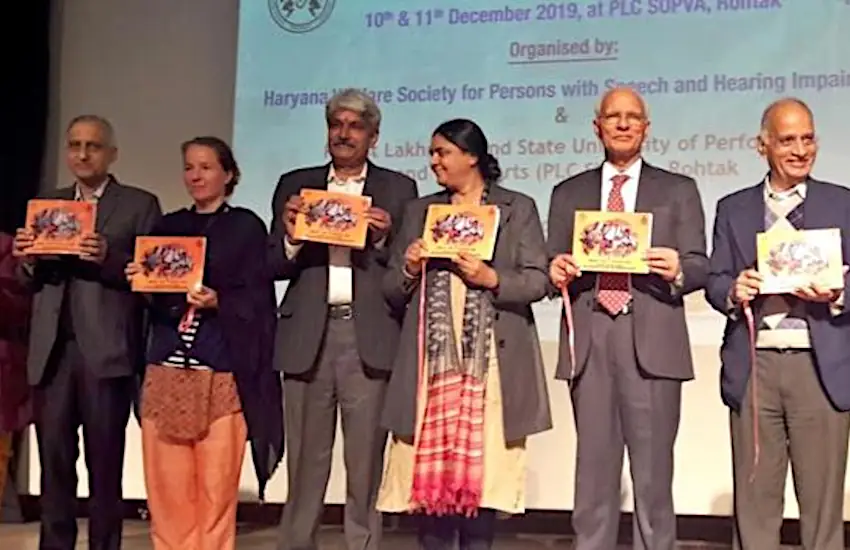
In India, most deaf and hard-of-hearing children are excluded from education. Only about five percent of them attend school at all, and just one percent receive a high-quality education. These numbers reveal a deep, long-standing crisis in India’s education system, especially in the areas of inclusion and accessible communication. The lack of sign language knowledge, trained teachers, and barrier-free learning materials prevents these children from developing their full potential.
Why Education Is So Difficult for Deaf Children in India
One of the biggest barriers for deaf children is language. Most schools do not offer instruction in Indian Sign Language (ISL). Only a few teachers know sign language, even though it is essential for students to understand lessons. According to Dr. Seema, head of the Gurugram Center of the Haryana Welfare Society for Persons with Speech and Hearing Impairment, nearly 98 percent of special educators in India lack proper sign language skills. As a result, many children understand lessons only partly—or not at all.
There is also a severe shortage of learning materials in sign language. Without visual or sign-based content, many subjects remain abstract and inaccessible. At an international conference on deaf education in Rohtak (Haryana), experts emphasized how strongly these communication barriers affect learning. When sign language is missing, children feel excluded and fall behind.
Lack of Early Support – Disadvantage Begins at Home
The challenges start long before school. Over 90 percent of deaf or hard-of-hearing children are born to hearing parents, who usually do not know sign language and have little access to early communication support. Many children therefore do not acquire a natural language early in life. This delay has serious consequences: children who do not learn a language in their early years struggle much more with reading, writing, and understanding lessons later on.
Early childhood support in sign language is essential for healthy language development. Without it, many children begin school with a severe disadvantage—one that the school system rarely manages to compensate for.
Few Secondary Schools and Limited Future Opportunities
In the state of Haryana, a welfare organization runs eight schools for deaf and hard-of-hearing students. However, only two of these schools—located in Karnal and Hisar—offer classes up to grade 12. The other schools stop earlier, forcing many students to end their education prematurely because no accessible secondary or vocational options exist.
There is no sign language university or accessible higher-education program in Haryana. This severely limits the future prospects of deaf young adults. Without barrier-free universities, they face major obstacles in entering qualified professions. Many end up in low-paid jobs despite having strong skills. Linguist Prof. Dr. Ulrike Zeshan from the University of Central Lancashire warns that the government must create better learning conditions and invest in accessible higher education.
Decisions Made Without Deaf People – A Key Structural Problem
Most policies and programs for deaf students are developed by hearing decision-makers. Deaf experts, educators, and researchers are rarely included in committees or political discussions. This leads to major problems: unsuitable curricula, ineffective teaching methods, and poor teacher training in sign language.
Deaf professionals such as Dr. Alim Chandani and Noah Ahereza argue that deaf people must be actively involved in shaping education policies. True inclusion requires that those affected have a voice in decisions. Without this, accessibility remains theoretical rather than real.
Digital Tools Offer New Opportunities
Despite the difficult situation, experts see hope in digital technology. Video-based learning materials in sign language, subtitles, and visually rich content can make lessons more understandable. Digital learning is especially useful in rural areas where sign language teachers are scarce.
Modern educational technology can make learning interactive, visual, and accessible—an important step toward equal educational opportunities.
Conclusion: Real Inclusion Requires Systemic Change
The education crisis for deaf children in India reflects deeper social inequality. Children who do not rely on spoken language are often left behind. As long as sign language does not have equal status in schools, teacher training, and educational policy, little will change.
A real transformation requires:
- a national strategy to promote Indian Sign Language,
- mandatory sign language skills for teachers,
- accessible digital learning materials,
- and active participation of deaf experts in all political and educational decisions.
India has the potential to become a leading example of inclusive education in Asia—but only if education becomes understandable, accessible, and barrier-free for all children.


