

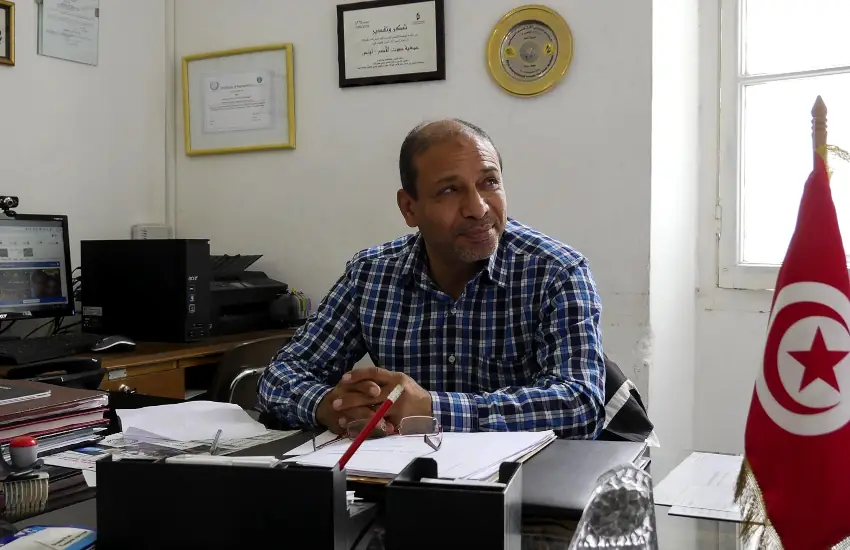
In Tunisia, many deaf people still struggle to access basic rights: education, employment, healthcare, and social participation. Although laws exist to promote equality and accessibility, the reality remains difficult for many. This report highlights the complex situation for deaf individuals in Tunisia, showing both progress made and areas where urgent action is needed.
Life Between Silence and Exclusion
Mohamed was born deaf. Growing up in a hearing family, he never learned sign language. As a child, he observed his family’s gestures and developed his own system to communicate. Later, he attended a so-called specialized school in the Bardo district. The school focused exclusively on spoken language – reading, writing, and sign language were neglected. After four years, he left without basic communication skills.
At 16, Mohamed completed an electrician training program and started working. Yet daily life remained full of barriers: limited knowledge of his rights, lack of support, and no access to interpreters. He only discovered the Association la Voix du Sourd (AVST) as an adult – an organization where deaf people meet, share experiences, and advocate for their rights.
Strong Laws – Weak Implementation
Tunisia has advanced laws protecting people with disabilities. In 2005, legislation required that at least 1% of employees in public administrations and large companies be persons with disabilities. In 2016, the quota was increased to 2%. Additionally, Tunisian Sign Language was officially recognized in 2006.
On paper, this looks promising – but in practice, many regulations are ineffective.
“In public institutions, quotas are sometimes respected, but in the private sector, hardly at all,” explains Ahmed Belazi from the Ministry of Social Affairs. While sanctions exist, no one monitors compliance.
Sami Ben Jemaa from Handicap International adds:
“Tunisia has progressive laws, but they remain a façade. There are almost no mechanisms to enforce them.”
Lack of Accessibility and Clear Responsibilities
Despite legal rights, many public buildings remain inaccessible. Even the Social Affairs Ministry in Tunis lacks barrier-free access.
The problem affects not only wheelchair users but also deaf and blind individuals. Many offices and hospitals do not provide sign language interpreters, and signage or digital systems for deaf citizens are scarce.
Ahmed Belazi points out:
“When people think of ‘disability’ in Tunisia, they almost always mean physical disability. The specific needs of deaf or blind individuals are often ignored.”
There are also overlaps and confusion between ministries. The Ministry of Social Affairs refers deaf people to the Ministry of Employment, which in turn directs them back – wasting time and leaving citizens feeling abandoned.
Education: Early Barriers for Deaf Children
Challenges start in early childhood. Tunisia has no clear guidelines on how to inform parents about their child’s deafness or how to support them. Many families are overwhelmed and unaware of possible educational paths and communication methods.
Approximately 90% of deaf children grow up in hearing families. Without support, they do not learn sign language and remain isolated linguistically.
Children who can use hearing aids (“appareillable”) may learn spoken language and later join mainstream schools. For others, specialized schools remain the only option – usually focusing on vocational training.
However, these schools often lack resources, interpreters, and teaching in sign language. Many deaf students finish school illiterate.
According to official statistics, 61% of people with disabilities in Tunisia are illiterate, and only 2.2% reach higher education.
Shortage of Interpreters and Lack of Language Standardization
A key issue is the limited standardization of Tunisian Sign Language (TSL). It includes regional variations and mixed elements from other languages. No governmental body oversees its development or standardization.
The Institut des Sciences Humaines (ISH) in Tunis has offered sign language interpreter training since 2003 – the only such program in the country. The number of interpreters remains extremely low.
The AVST tries to fill this gap, offering free sign language classes for deaf and hearing people every Saturday, helping participants learn and break communication barriers.
Daily Life Full of Obstacles
The lack of interpreters has serious consequences, particularly in healthcare.
Many deaf people need a hearing companion to visit doctors, violating confidentiality and often leaving medical information misunderstood.
“How can a deaf person explain abdominal pain if they lack vocabulary?” asks Dr. Amira Yaakoubi from AVST.
To address this, AVST offers health awareness workshops. Deaf participants learn medical terms in sign language and discuss broader societal issues such as sexuality and gender-based violence.
Yaakoubi recalls:
“Many deaf women did not understand sexual assault or knew they could seek help after rape. Our workshops raise awareness and can change lives.”
Digital Opportunities: Internet and Video Communication
Digital tools offer hope.
Previously, deaf people needed interpreters to make phone calls. Today, video calls, smartphones, and social media allow direct communication in sign language.
“Previously, a five-minute phone call took thirty minutes. Now, video is enough,” explains audiologist Lotfi Zekri.
The internet provides access to information, social networks, and education. However, barriers remain: many online materials lack captions or sign language versions.
Tips for Better Inclusion
- Early Support: Parents of deaf children should receive counseling and sign language courses early.
- More Interpreters: Expand training programs and ensure fair pay for sign language interpreters.
- Accessible Communication: Captions on TV, government websites, and public services should be standard.
- Healthcare Awareness: Medical staff should learn basic sign language.
- Digital Accessibility: Increase sign language videos and simple, understandable content online.
Conclusion
Mohamed’s story illustrates the gap between Tunisia’s legal framework and the reality for deaf people. Lack of interpreters, unclear ministry responsibilities, and an education system not designed for sign language leave many deaf individuals marginalized.
Yet a new generation of activists is emerging, supported by organizations like AVST and modern technology.
The road to full equality remains long. Each initiative, sign language class, and barrier-free information system brings Tunisia closer to an inclusive society where deaf people are no longer overlooked.


