

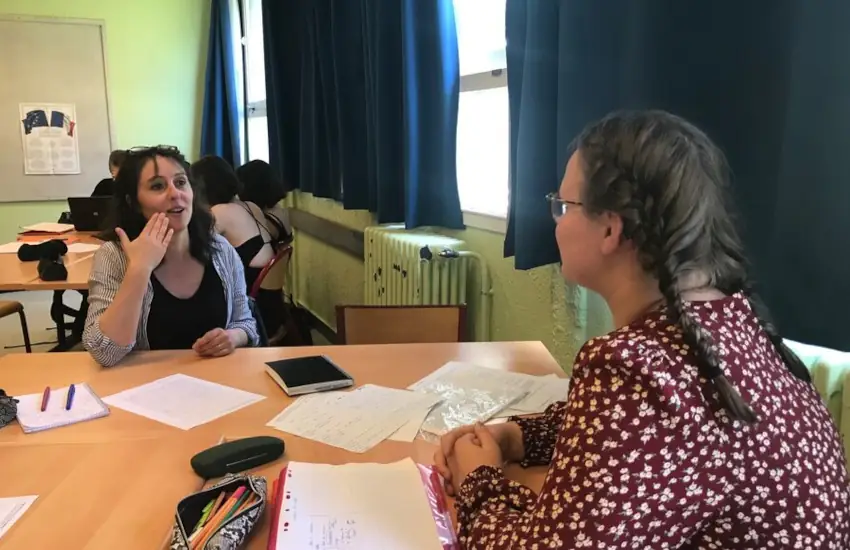
Since the 2023 school year, there has been a serious issue in the French department of Calvados: many hard-of-hearing children are no longer receiving adequate support in school. They no longer have access to “coders” – specially trained professionals who use hand signs to visually represent spoken language. This method is known as French Cued Speech (Langue française parlée complétée) and it significantly helps hard-of-hearing students understand spoken content in the classroom.
Although a court has already ruled that this support must continue, the education system has been too slow to respond. The affected families are disappointed and continue fighting for equal educational opportunities.
What Is Cued Speech and Why Is It Important?
Cued Speech is not sign language. It is a distinct visual language that complements spoken words with specific hand signs. These signs make visible what lipreading alone often cannot detect – such as syllables or similar-sounding words.
The goal: hard-of-hearing children can better follow the lessons, stay focused longer, and are less exhausted by the end of the day.
Aurélie Lemarié, the mother of an affected child, reports: “Since my son lost his coder, he’s much more tired. He’s withdrawing and feels left out.”
What Happened?
Until 2023, eight professional coders were working in the Calvados region, funded by local authorities. But suddenly the funding was cut. This meant the coders could no longer be deployed. The national government offered to hire them as basic support assistants (AESH) – but under a completely different job structure. Many rejected the offer, as it did not match their profession or qualifications.
Some parents tried to pay for coders themselves. But it’s expensive – and not every family can afford that.
Court Ruling – But Little Change So Far
In June 2024, a court ruled that the French state – represented by the Ministry of Education – must provide better support for hard-of-hearing children. The families were proven right. But the court decision alone has not yet brought a quick solution.
The Ministry of Education announced it would train eight new assistants (AESH). However, these assistants currently receive only 40 to 45 hours of training – far too little. To become a qualified coder, one needs at least 400 hours of training and hands-on practice.
What Are the Families Demanding?
The affected parents, especially those organized in the parent association Apedac, are demanding:
- professionally trained coders with sufficient experience,
- immediate solutions for the affected children,
- more staff in schools – not only in coding support, but in general services for hearing-impaired children,
- equal opportunities for their children, just like for all others.
They also point to other regions in France that already cooperate with professional coding service providers.
Conclusion: The Children Must Not Be the Ones to Suffer
The situation in Calvados shows how quickly hard-of-hearing children can be left behind – even when the law is clear. Despite a court ruling, implementation remains slow and uncertain. Parents continue to fight for their rights – for true inclusion, equal chances, and an education system that excludes no one.
The parents’ main message is: Hard-of-hearing children need professional support now – not someday in the future.


